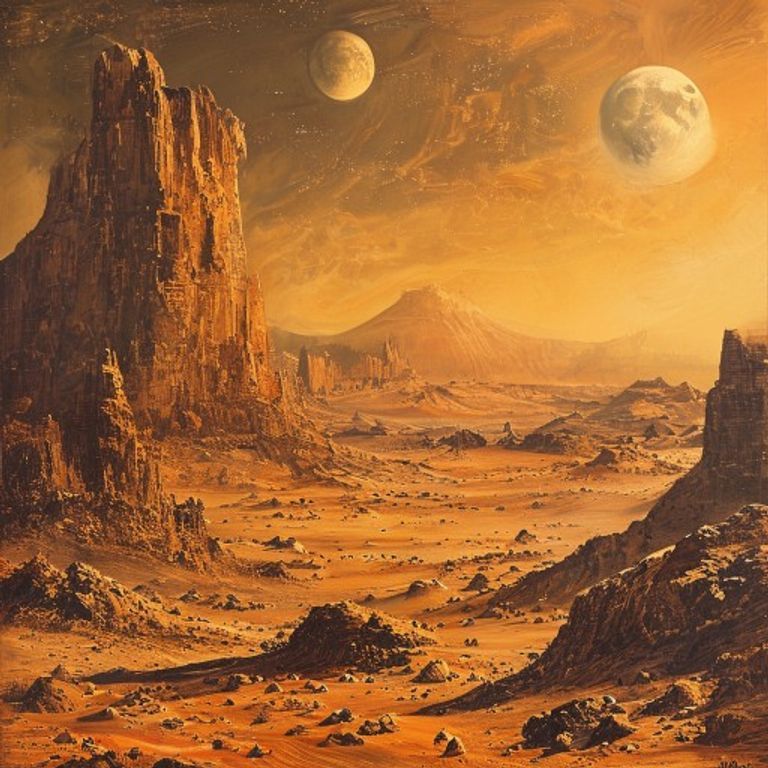

Beneath a sky swirling with molten amber and oxidized gold, an alien world breathes with the tortured beauty of a master’s brushstroke — vast, ancient, and utterly silent. Towering mesas of rust-colored stone rise like cathedral spires from the ochre plains, their sheer vertical faces carved by millennia of cosmic wind into something resembling divine architecture. Two celestial moons hang luminous and heavy in the turbulent heavens, one pale and distant, the other vast and cratered, casting an otherworldly luminescence across the barren expanse below — as though Mars itself were being watched by patient, indifferent gods. The desert floor stretches endlessly toward a volcanic peak on the horizon, its slopes half-dissolved in the haze of a perpetual mineral dust that blurs the boundary between earth and atmosphere. Every surface pulses with Van Gogh’s unmistakable chromatic intensity — burnt sienna, deep umber, raw saffron — colors that feel less painted than erupted from some deep geological emotion. This is not merely a landscape but a reckoning: the collision of post-impressionist soul with the cold sublime of interplanetary wilderness, resulting in a vision that is simultaneously scientific and sacred.
Additional Captions:
• Twin moons preside over a Martian wilderness painted in the feverish palette of post-impressionism
• Ancient stone monoliths rise like forgotten monuments across an endless rust-colored plain
• A volcanic peak dissolves into golden haze at the edge of an alien horizon
• The crimson desert floor stretches toward infinity beneath a sky alive with swirling cosmic energy
• Van Gogh’s tortured brilliance reborn in the silence of a world no human eye has ever witnessed